Wicket doors – also known as integral pedestrian access doors – are a clever solution for providing entry through a roller shutter or industrial door without opening the entire thing. Imagine a small door within your large shutter: it lets people walk in and out easily while the main shutter stays secure. This feature is popular in warehouses, factories, and commercial units where you might not have a separate entrance handy. In this post, we’ll explain what wicket doors are and how they work in roller shutters and steel industrial doors. We’ll explore the key benefits (like convenience and energy savings) and the limitations (such as size and accessibility considerations). For architects and business owners, we’ll also cover typical sizing options and important DDA compliance notes – since accessibility and safety regulations can determine whether a wicket door is suitable. By the end, you’ll know which Security Direct products offer wicket doors and how they can enhance your premises. Let’s dive in!
What Is a Wicket Door in a Roller Shutter?
A wicket door is essentially a smaller hinged door built into a larger door or shutter. In the context of roller shutters (or sectional industrial doors), it’s a personnel-sized door set into the curtain of the shutter. When the roller shutter is down (closed), the wicket door provides a convenient walkthrough for people. It’s like having a pedestrian door within your roller shutter or steel door. This means you don’t need to roll up the entire shutter just to let someone in or out – the wicket door can be unlocked and opened independently for quick access.
Within a roller shutter, the wicket door is usually constructed from the same material and slat design as the shutter itself, so it blends in. It’s typically installed in the lower portion of the shutter curtain, framed with its own steel edges and hinges. When the wicket is opened, it swings on its hinges to allow passage. On roller shutters, the wicket door will usually swing outward or inward (depending on design) and must be fully opened before the main shutter operates. Modern installations include safety interlock switches, so if the wicket door is not closed (or folded back in the open position for some shutters), the electric motor of the shutter won’t engage. This prevents damage by ensuring the shutter isn’t raised while the wicket is in the way.
In industrial sectional doors (the kind that lift panel by panel), wicket doors function slightly differently: the integrated door can actually move with the sectional door when it opens. These often have built-in flush hinges and sensors so you can open the entire door normally if the wicket is closed. In both cases, the wicket door features standard door hardware – typically a lock (e.g. a keyed cylinder lock or thumb turn) and sometimes panic bar hardware if it’s to be used as an emergency exit.
Key point: A wicket door provides pedestrian access through a larger shutter or door. It’s ideal for scenarios where you want security but also need regular entry for staff or visitors without the hassle of raising a big industrial door each time.
Benefits of Wicket Doors
Wicket doors offer several advantages for businesses and facilities. Here are some of the top benefits:
- Convenience for Foot Traffic: The primary benefit is easy access for people. Instead of rolling up an entire shutter (which takes time and energy), a wicket door lets staff or visitors walk straight in. This is especially useful if you have frequent small deliveries or employees coming and going. The main door stays closed, and people can come through the wicket quickly – saving time and effort every day.
- Energy Efficiency & Climate Control: Every time you open a large roller shutter, you let the outside weather rush in – losing heat in winter or letting hot air inside in summer. Using a wicket door minimises this. You’re only opening a small portion of the door, which reduces heat loss or gain and helps maintain interior temperatures. Over time, this can save on energy costs for heating or cooling, since your warehouse or shop isn’t constantly exposed to the elements.
- Enhanced Security (Keep Main Door Closed): With a wicket door, the big shutter or industrial door remains closed and locked, so your premises stays secure even as people enter or exit. You’re not repeatedly opening the full-width entrance, which could attract unwanted attention or allow unauthorised entry. The wicket door itself can be locked when not in use, typically with a robust lock. While an integrated door isn’t quite as robust as a full separate steel door in a wall, it still provides a level of security and keeps the main barrier in place. It’s a cost-effective alternative to installing a separate pedestrian entrance when the building structure doesn’t allow one.
- Operational Efficiency: For busy operations, wicket doors improve workflow. Staff can quickly move between areas without waiting for large doors to cycle open. This can also prolong the life of your main shutter’s motor and components – since you’ll operate the big roller door less frequently, reducing wear and tear. Some models even allow retro-fitting a wicket door into an existing roller shutter, meaning you can upgrade older doors for convenience without a full replacement.
- Emergency Egress Option: In situations where there is no other personnel door, a wicket door can double as an emergency exit in a pinch. For example, if a warehouse has only a roller shutter as the entrance, adding a wicket with panic bar hardware can provide an escape route for staff during a fire alarm. However, note the limitations in the next section – a wicket door used as a fire exit must meet certain size requirements and isn’t suitable for all scenarios. Flexible Design: Wicket doors can be configured to open inward or outward, depending on your space constraints. This flexibility means you can choose the swing direction that won’t obstruct interior equipment or exterior walkways. They can also be color-matched to your door. For instance, at Security Direct we can powder-coat the wicket door frame and panels to match the roller shutter curtain, giving a neat, uniform appearance that doesn’t disrupt your building’s look.
Limitations and Considerations of Wicket Doors
While wicket doors are useful, it’s important to understand their limitations. They aren’t the perfect solution for every situation. Consider the following:
- Size Constraints: By nature, a wicket door is smaller than a standard standalone door. The opening is usually narrower and a bit shorter. Many integrated doors are only around 600–800 mm wide (roughly 2–2.5 feet) and 1600–1800 mm tall (5 to 6 feet). Taller or larger “wicket” designs exist (some can be nearly full door height), but those may require a bigger overall door frame. For tall individuals, ducking might be necessary through a smaller wicket. Large equipment or bulky items certainly won’t fit through; they’ll still require the main shutter to open.
- Threshold / Step-Over Bar: Most wicket doors in roller shutters have a raised bottom frame that you have to step over. This bottom rail is there because it’s part of the shutter structure. It typically creates a trip hazard and means wheeled carts or pallet trucks can’t roll through easily. More critically, this threshold makes the wicket door inaccessible to wheelchairs in most cases. We’ll discuss disability access in the next section, but in short, the threshold bar is an important safety consideration – anyone using the door must mind their step to avoid tripping.
- Not Suitable for Heavy Traffic or Large Crowds: Because of their size and the step-over, wicket doors are not ideal for situations where lots of people need to pass through quickly or simultaneously. For example, retail stores or public venues should have proper exit doors. A narrow wicket door can slow down evacuation and create a bottleneck. In fact, building regulations may prohibit counting a small wicket as an official emergency exit if occupancy is above a certain number (more on compliance below). Wicket doors work best for occasional use by individuals or small groups, not as primary doors for customer entry.
- Impact on Door Strength: Adding a cut-out door into a roller shutter or sectional panel slightly alters the door’s structural integrity. Manufacturers design wicket doors carefully to maintain strength, but it’s worth noting that the area with the wicket may be somewhat less robust than a solid door section. Novoferm (a door manufacturer) notes that integrated wicket doors “do not improve the stability of the door” and come with restrictions on width/height, meaning they might not meet certain standards for escape doors. In practice, as long as the wicket is professionally installed by the manufacturer (with reinforced framing), the door will still be secure – but it’s not as strong as a wall with a separate steel door.
- Operational Procedure (Training Needed): For roller shutters, the wicket door and its frame usually have to be fully opened (hinged out of the opening) before operating the main shutter. This is a safety feature – if someone tried to raise the shutter with the wicket closed, it could clash and cause damage. Electrical interlocks prevent that, but users need to know the correct procedure: unlock and open the wicket fully (often it swings out and latches to the side) before hitting the roller shutter open button. If your staff aren’t aware, they might find the shutter “won’t move” – because the interlock is doing its job. Proper training or clear signage can solve this. It’s a minor inconvenience but a necessary one. (On sectional doors, this is less of an issue since the wicket door stays closed and just lifts with the panels, but there’s still usually a sensor that the wicket must be closed to lift.)
- Limited Aesthetics: This is subjective, but some building owners feel that a door cut into a shutter isn’t as aesthetically clean as having a separate entrance. The wicket will have a visible frame within the shutter curtain. However, as mentioned, we can color-match and design it to blend as much as possible. For most industrial settings, this isn’t a big concern, but for a storefront you might consider how the wicket door looks on your closed shutter (from a customer-facing perspective).
Security Direct Products with Wicket Door Options
Many of Security Direct’s door solutions can be configured with an integrated wicket door for pedestrian access. If you’re considering this feature, here are the product types we offer that support wicket doors:
- Industrial Roller Shutters: Our heavy-duty industrial steel roller shutter doors can be ordered with an optional wicket door built into the curtain . This option is popular for warehouses and loading bays. For example, the Security Direct RS75 Industrial Roller Shutter (a robust 75 mm slat steel shutter) is available with a wicket door feature. This gives you the convenience of access without opening the 7-meter-wide shutter every time. The wicket door is manufactured from the same steel laths, maintaining a uniform look and security level. (Internal Link: Interested readers can check our Industrial Roller Shutters page for details on models like the RS75 and their options.)
- Insulated Sectional Doors: We offer insulated sectional overhead doors for industrial units, which can include built-in wicket doors as well. Sectional doors are often used in factories and commercial garages where insulation is important. With a wicket door, you get personnel access while keeping the insulated panels closed, retaining heat. Our sectional doors can be fitted with various wicket door configurations – including options with low-profile thresholds in some cases. (Internal Link: See Industrial Sectional Doors on our site for specifications and wicket door add-ons.)
- High-Speed or Specialty Doors: Generally, high-speed roll-up doors or PVC curtains do not incorporate wicket doors (their design isn’t suited for it). However, some large sliding steel doors and specialist doors can have integrated access doors. For instance, certain fire-rated sliding doors we supply (for large openings) can be built with one or two pedestrian wickets for emergency egress. These are more niche use-cases (like in big industrial complexes or aircraft hangars), but if you have a very large door with no nearby exit, this option exists. These special wicket doors can even be made almost full size – one of our fire sliding door models offers a 1200 mm x 2100 mm wicket door that’s designed for wheelchair access and has no floor threshold (it’s flush with the floor for safety). Such features ensure compliance even in massive door systems.
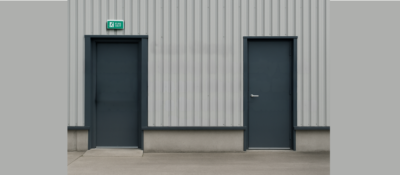
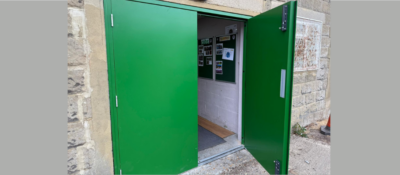
- Steel Personnel Doors (Alternative): It’s worth mentioning an alternative: if an integrated wicket door isn’t suitable for your needs (for instance, due to DDA compliance issues), you might consider installing a separate steel security door adjacent to your shutter. Security Direct provides a wide range of steel personnel doors (security rated, fire exits, etc.) that can serve as your pedestrian entry. While this means creating a new opening in the building, it can sometimes be the best solution for high-traffic or accessibility needs. Browse our Steel Security Doors section to see options for standalone personnel doors. In scenarios where you can accommodate a separate door, it might be easier to meet accessibility regulations (flat threshold, wider opening) with a purpose-built steel door, rather than using a wicket door. We’ll discuss DDA compliance next.
Sizing Options for Wicket Doors
How big (or small) can a wicket door be? Sizes do vary by product and manufacturer, but here are some typical guidelines:
- Standard Size: Many roller shutter wicket doors are fairly compact. A common “standard” wicket might have a clear opening roughly about 500–600 mm wide and 1500–1600 mm high (approximately 20–24 inches by 5’3” in feet). For example, one industry standard wicket door size is a clear opening of about 565 mm x 1605 mm. The frame of the door is larger (since it includes the perimeter), perhaps around 770 mm x 1770 mm in that case. This size is usable for most able-bodied adults, but it’s a tight fit and you do have to stoop a little if you’re tall.
- Large (“Euro”) Size: To address the height issue, many suppliers offer a bigger wicket door option – often called a “Euro” wicket or full-height wicket. These typically have a clear opening on the order of 800 mm x 1800+ mm. For instance, a clear opening of 800 mm width by 1830 mm height is one such option, with an outer frame around 1000 mm x 2000 mm. In practical terms, this gives you about 6 feet of headroom and just over 2.5 feet of width. It feels much more like a normal door and is certainly more comfortable to use. The wider width (800 mm) is also significant because it approaches the minimum width required for wheelchair access – though the threshold bar still remains an obstacle (more on that below). This larger wicket is great for situations where a lot of people will use the door, or you simply want easier passage.
- Extra-Large or Custom: In specialised industrial doors (like the sliding fire doors mentioned earlier), you may find even larger integrated door sizes, such as clear openings of 1000 mm or more in width and over 2000 mm (6’6”) in height. A 1000 mm width is roughly 39 inches – wide enough for most wheelchairs – and when combined with a flush threshold it can meet accessibility requirements. However, these sizes are usually only possible in very large door systems that can structurally support such a big cut-out. They are custom solutions rather than standard offerings. For most roller shutters and sectional doors, the “Euro” 800×1800 mm range is about the upper limit for an integrated wicket door.
- Threshold Height: The height of the bottom threshold (the step-over piece) can vary. Standard roller shutter wickets might have a threshold of 50–150 mm (2–6 inches) high – enough to be a noticeable step. Some sectional doors come with low-profile thresholds, as low as 15–20 mm (under 1 inch). The trade-off is that ultra-low thresholds often are available only on outward-opening wickets and may not be as robust. When choosing a wicket door, consider how important a low threshold is to you: if hand trucks or wheelchairs will ever need to pass, ask about low-profile options.
In summary, you should work with our team to determine the appropriate wicket door size for your needs. We will ensure the wicket fits within your chosen door model’s constraints. Security Direct can advise on standard vs. oversized wicket doors depending on your use case. Keep in mind that opting for a larger wicket may require a larger overall door width or certain reinforcement, so it’s something we plan for in the design stage.
DDA Compliance and Accessibility
One critical consideration is whether a wicket door meets accessibility standards – especially the Disability Discrimination Act (DDA) requirements (now encompassed under the Equality Act in the UK) and Building Regulations for access. In most cases, a standard wicket door will not be DDA compliant as an access route. Here’s why:
- Threshold Barrier: As noted, the typical wicket door has a bottom frame that creates a step or trip hazard. DDA guidelines (and Part M of building regs) call for level or ramped thresholds no higher than about 15 mm for wheelchair users. Standard roller shutter wicket thresholds far exceed this (often 50+ mm high), meaning a wheelchair cannot roll through. From an accessibility standpoint, that threshold is a deal-breaker – it’s not considered an “accessible entrance” if you have to step over something. Some advanced designs eliminate the threshold (flush floor, using automatic drop seals, etc.), but these are exceptions and usually in specific door types (e.g., certain sectional or sliding doors). For general planning: assume a wicket door is not suitable for wheelchair access.
- Narrow Width: Many wicket doors are too narrow to meet the recommended clear opening width for disabled access (which is typically 800 mm minimum in the UK for wheelchair entry). A standard small wicket (500–600 mm wide opening) is way under the requirement. Even the larger ~800 mm clear width wicket just barely meets minimum door width guidelines. If a mobility aid user needs to use the door, 800 mm is the bare minimum and even that can be tight. Additionally, the door may not have the required clear space alongside for maneuvering, etc., as it’s within a bigger door. Bottom line: if you need an entrance to be fully accessible, an integrated wicket is unlikely to suffice, unless it’s one of the specially designed large/threshold-free variants.
- Regulatory Use as Fire Exit: Let’s say you hoped the wicket door could count as your accessible fire exit. Building Control and fire officers are often hesitant to accept a wicket door for this purpose. Regulations demand that escape doors be readily usable by all. Because of the issues above (step and narrow width), a wicket gate might not comply with the standards for an escape route door. It may also be harder to open for some users (some have spring closers, etc. that add resistance). If your building requires a certain number of fire exits or accessible entrances, you will likely need a full-size compliant door (with panic hardware, correct signage, etc.) rather than relying on a wicket. Always check with local building authorities or fire safety consultants if in doubt. As one manufacturer advises, “always check with local authorities to ensure you choose the correct wicket door” if you intend it for escape use.
- When Is a Wicket Door Acceptable? Wicket doors are best viewed as convenience access for able-bodied persons in addition to your code-compliant entrances. They are not typically considered suitable as the sole means of disabled access to a building. If your facility has other entrances (e.g., a front door or a side fire exit) that are DDA compliant, then having a wicket in a shutter is fine for convenience of staff. However, if the shutter + wicket is the only way in/out, you likely won’t meet DDA standards – which could be a legal issue for workplaces or public spaces. In such cases, plan to either: (a) install a separate accessible door, or (b) use a specialised door system with an integrated compliant wicket (again, rare and usually more expensive).
Tip: If accessibility is a concern, talk to our team about alternatives. We might recommend pairing your roller shutter with an adjacent pedestrian door that is wheelchair-friendly (level threshold, wide opening). Sometimes a manual override or remote control can allow disabled users to operate the full shutter when needed, instead of using a wicket. Every situation is different, so planning for DDA compliance is key.
Summary
Wicket doors in roller shutters and industrial doors offer a smart balance between security and accessibility. They function as a convenient “door-within-a-door,” letting you or your staff enter and exit quickly without fully opening massive shutters each time. This improves daily efficiency and can help maintain climate control and security on your premises. We’ve discussed how wicket doors bring benefits like convenience for foot traffic, energy savings, and even potential emergency egress in a pinch. We’ve also covered their limitations: notably the step-over threshold and smaller size that make them less suitable for wheelchair users or heavy pedestrian flow. It’s crucial to weigh these factors and consider building regulations – often, a wicket door is a secondary convenience rather than a primary public entrance.
The good news is that Security Direct offers a range of products that incorporate wicket doors, from commercial roller shutters to industrial roller shutters, so you have options to choose from. Our team can guide you on the right wicket door solution and ensure it’s installed safely and meets your needs.